All Posts By

Natalie Conseur

Pentecost Sunday

John 14:15

If you love me, you will keep my commandments.

Readings for Pentecost Sunday (during the day): Acts, Romans, John

Reflection:

Have you ever wondered why we call ourselves Catholic Christians? We read in the book of the Acts of Apostles in the Bible: “Then he (Barnabas) went to Tarsus to look for Saul, and when he had found him he brought him to Antioch. For a whole year they met with the church and taught a large number of people, and it was in Antioch that the disciples were first called Christians.” A Christian is one who believes in Jesus, the God-man, who saves the world by his passion, death, and resurrection. A Christian believes that Jesus is the Son, who teaches us about the Father and the Holy Spirit; one God in three persons.

It is again from Antioch that we received the second part of our name. St. Ignatius of Antioch, writing in 107AD, spoke of the Church as “Catholic,” specifically with the Greek word katholicos, meaning “universal.” The Church is for everyone, Jews and Greeks/gentiles. It doesn’t matter from which country or people you come; God calls everyone to belong to himself in Christ Jesus.

As far as the word “Church” is concerned, it is Greek, ekklesia, meaning “(those) called out of.” The Church is comprised of Jews and gentiles: those called out of sin and death into life, those called out of darkness into light.

That is why in today’s second reading, St. Paul reminds us that, “[I]n one Spirit we were all baptized into one body,
whether Jews or Greeks, slaves or free persons,
and we were all given to drink of one Spirit.” The new covenant that Jesus established opened the doors of salvation to the whole world. Pentecost is when the mission truly began. The Holy Spirit descended upon the apostles, empowering them to speak in many languages and boldly proclaim the Gospel. People from all nations understood them, a clear sign that the Church was for everyone. Today, the Catholic Church continues this mission. With over a billion members worldwide, we are still one body in Christ.

Reflection Questions

  • What does it mean to you personally that the Catholic Church is “universal” and open to all people, regardless of background or nationality?
  • In what ways can you, like the apostles at Pentecost, be bold in sharing your faith with others today?
  • How does understanding the origins and mission of the Catholic Church help you grow in your relationship with Christ and the larger Christian community?

Ascension of the Lord

Luke 24:48

You are witnesses of these things.

Readings for the Ascension of the Lord: Acts, Hebrews, Luke

Reflection:

“All the world’s a stage, and all the men and women merely players,” wrote Shakespeare. While he may have meant it metaphorically, there is something profoundly true in that statement—especially when we speak of the drama of salvation.

This divine drama isn’t make-believe; it is the true story of history—our relationship with God unfolding across time. God built the stage—our universe—and placed us, real people, into His story. From the beginning, He desired a relationship with us. But the devil sought to disrupt this divine play by tempting humanity into sin.

Yet the most remarkable twist in this drama came when God Himself took the stage. In Jesus Christ, God entered history. By His death and resurrection, He restored what was broken. The drama could now continue. But surprisingly, Jesus didn’t stay on stage.

His Ascension wasn’t an exit, but an invitation—for us to step into His role. The Church, His body, now carries on His mission.

Had Jesus remained visibly among us, we might have only sat at His feet. Instead, He ascended so we might rise, filled with the Holy Spirit, to be “little Christs”—active in the world, continuing His work.

But the drama isn’t over. As the angels told the apostles, Jesus will return. The story ends when the Church, transformed and united in love, gathers around Him once more. Until then, the curtain remains open—and we each have a role to play.

So, remember: the drama of salvation is still unfolding—and you are part of it.

Reflection Questions

  • What role do you see yourself playing in the drama of salvation, and how might God be inviting you to step more fully into that role?
  • Why do you think Jesus chose to ascend and leave the stage rather than remain physically present, and how does that change your understanding of the Church’s mission today?
  • In what ways can you respond to the promptings of the Holy Spirit in your daily life to grow closer to God and others?

Eighth Sunday in Ordinary Time

Luke 6:45

A good person out of the store of goodness in his heart produces good.

Readings for Sunday: Sirach, 1 Corinthians, Luke

Reflection:

If an anthropologist from the future, traveling back in time with an invisibility cloak could observe you every day, all day, for months: what type of report would he write? It is easy for us to declare what our ideals are, but talk is cheap. How do we actually live? In the Gospel for this Sunday, Jesus says, “A good tree does not bear rotten fruit, nor does a rotten tree bear good fruit. For every tree is known by its own fruit… A good person out of the store of goodness in his heart produces good, but an evil person out of a store of evil produces evil; for from the fullness of the heart the mouth speaks.” We all like to think of ourselves as good people, yet, if we are honest, we not only sin but even have thought patterns that are not always good. We judge people, we lust, and we are often selfish and self-centered.

Holiness is not simply avoiding sin; though to be clear, we should not sin. Holiness, in the end, is about conformity to Jesus Christ. It is to become just like him: to be a son or daughter of God in and through the Son of God.

To think like him, be like him, take on his dispositions and, in the end, act like him. That is why the Catholic Church teaches both about what entertainment we “consume” and the inculcation of virtue, that is, good habits.

Regarding entertainment, as well as books and so on, the Church teaches us to choose carefully. We like to think that we have great mental filters, and that we can filter out bad material. But that is not true. After all, have you ever had a song stuck in your head? How did it get there? Virtue is the day in and day out doing of good things, to the point that they become habit. Habits can be good (virtues) or bad (vices). We want to be so like Jesus Christ that it becomes “natural;” we want to be holy.

Reflection Questions

  • In your prayer ask: What TV shows, internet content, books, etc. do I watch and read?  Is it good? Does it lead me to Jesus Christ or away from him?
  • Reflect on this: What are my vices? Am I cultivating virtue in my life; am I working on eliminating my vices?
  • Consider in quiet reflection: What type of report would an invisible anthropologist write about me after observing just how I live every day, let alone what I think?

Seventh Sunday in Ordinary Time

Luke 6:27

Love your enemies, do good to those who hate you.

Readings for Sunday: 1 Samuel, 1 Corinthians, Luke

Reflection:

Sometimes Jesus’ commands seem crazy; for example, in today’s Gospel, he tells us to “love our enemies, do good to those who hate you.” Yet, if we understand it, it makes perfect sense. In the first place, the actual word in the original Greek text is Ἀγαπᾶτε (agapate); it is the command form of the verb agapaó, “to love.” But this is different than the other Greek words for love such as phileō (brotherly love, the love of friends), stérgō (family feeling), éramai (physical love, romantic love, sexual love). Agapaó means to do good for the other person without expectation of repayment. It has nothing to do with how you feel, rather, it is about what you do. Jesus would ultimately say, “No one has greater love (agape) than this, to lay down one’s life for one’s friends.

We, as sinners, were in a sense God’s enemies. St. Paul wrote, “God proves his love for us in that while we were still sinners Christ died for us” (Romans 5:8). We see God’s love for us in the Cross. We see God’s love in what he did for us, not expeting repayment because it is impossible to buy or earn or compensate God’s for our salvation. As God loves us, we are to love others, even our enemies.

There is a difference between authentically loving someone and liking someone. Liking someone means you enjoy being around that person, and or you agree with that person, and so on. You can truly love (agapaó) someone while not liking him. You can like someone without truly loving her. We have probably all had friends who like us but didn’t truly love us: they were not there when we truly needed them or they were not willing to do good for us without expecting some kind of payment or return. Jesus is not like that: he truly loves us, even when we are not being very likable; he truly loves us even though we are sinners.

Reflection Questions

  • In your prayer ask: Do I distinguish, in my own mind, loving someone from liking someone? Do I truly love God and my neighbor, or do I sometimes only “like” them?
  • Reflect on this: How can I love my enemies by doing good to them, even when I don’t like them? How can I desire the greatest good for my enemies, even if it isn’t to my advantage?
  • Consider in quiet reflection: How strong must Jesus’ love for me be, if he became human, and then suffered and died on a cross to save me, sinner that I am?

The Presentation of the Lord

Hebrews 2:17

...he had to become like his brothers and sisters in every way, that he might be a merciful and faithful high priest before God
to expiate the sins of the people.

Readings for Sunday: Malachi, Hebrews, Luke

Reflection:

At the Field Museum there was an exhibit filled with shoes—endless varieties from around the world, even boots. A sign read, “Walk a mile in my shoes,” inviting us to understand others’ lives by imagining their journeys. It was inspiring. But something was missing—a pair of sandals, worn by a Jewish carpenter from Nazareth named Jesus.

Those sandals represent something profound: that God Himself understands us. God, as God, knows everything.Yet in Jesus, God takes our humanity, walking among us, experiencing life as we do.

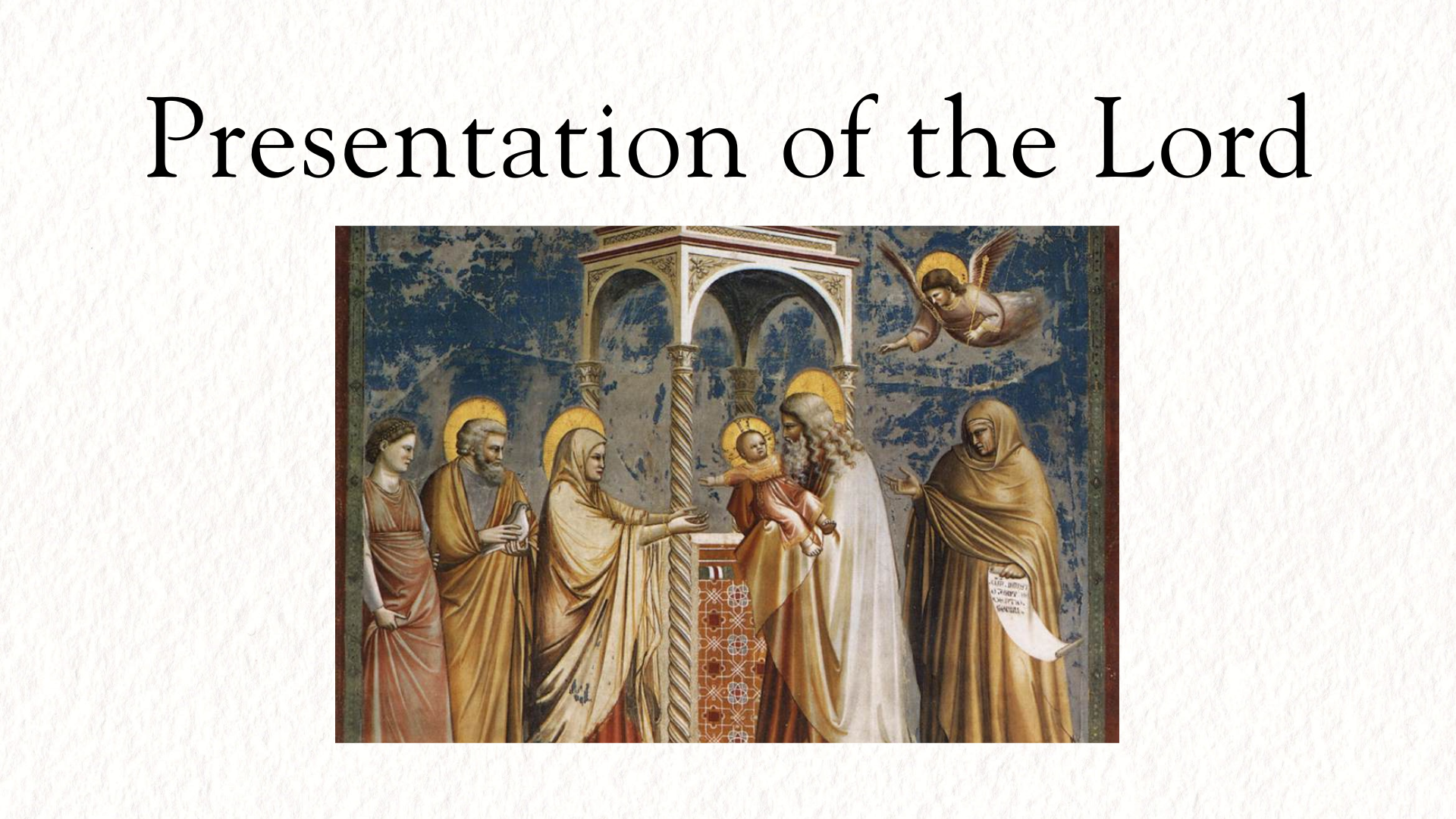
The feast we celebrate today, the Presentation of the Lord, reminds us of this incredible truth. Mary and Joseph brought Jesus to the temple—the place where God’s glory, His shekinah, dwelled among His people.

For centuries, that glory had seemed distant—hidden behind the curtain of the Holy of Holies, accessible only to the high priest, and only once a year at that. But Malachi foretold a day when the Lord Himself would come to His temple. And when He did, it wasn’t with fire and lightning, but as a baby in His mother’s arms.

In Jesus, the glory of God walked a mile in our shoes. He shared in our joys and sorrows, even our death, to save us from sin and bring us into a new relationship with God—as His beloved children.

So, when life feels dark or overwhelming, follow Simeon’s example. Keep your eyes on Jesus. Because in Jesus, our God is with us in our experience, even when life is hard.

Reflection Questions

  • In Your Prayer Ask: How does knowing that Jesus “walked a mile in our shoes” change the way you view your relationship with God? How can this truth bring you comfort in moments of darkness or difficulty?

  • Reflect on This: Simeon waited his whole life to see Jesus, trusting in God’s promise. What are you waiting for or trusting God with right now? How might keeping your eyes on Jesus help you find hope and strength in your journey?

  • Consider in Quiet Reflection: The museum exhibit invited visitors to “walk a mile” in someone else’s shoes. How can Jesus’ example inspire you to better understand and show compassion to others? Who in your life might need you to walk alongside them today?

Join us for our Mass livestream Watch Online