Category

Path To Sunday

14th Sunday In Ordinary Time

Luke 10:2

"The harvest is abundant but the laborers are few."

Readings for Sunday: Isaiah, Galatians, Luke

Reflection:

Why do Catholics display crucifixes rather than empty crosses? The answer lies in what the crucifix proclaims. First, when St. Paul boasts only in, “the cross of our Lord Jesus Christ” (Gal 6:14) he never imagines a bloodless beam. For him “the cross” always means the suffering Lord—“we preach Christ crucified”
(1 Cor 1:23). A crucifix makes that invisible proclamation visible: yes, Christ is risen, but the victory was won through a real death freely offered for us.

Second, the corpus reminds us at once of the price of sin and the immensity of divine love. Gazing on the Crucified we recall that, “Christ suffered for sins once, the righteous for the sake of the unrighteous” (1 Pet 3:18). Healthy guilt is not morbid; it can lead to repentance. And repentance is necessary if we want to receive God’s forgiveness.

When forgiven, we should respond with gratitude. Like the debtor who loved the creditor more after forgiveness (Lk 7:41-43), we love God more deeply because we see what redemption cost Him. Ultimately, the image of Christ Crucified is a reminder of the radical love God has for us.

Third, the crucifix keeps our eyes fixed on salvation, not self-help. Some preachers promise earthly blessings in the sense of health and wealth, yet St. Paul—martyred for the gospel—trained, “to win an imperishable crown” (1 Cor 9:25). Christ on the cross tells us discipleship is costly (“Jesus said to his disciples, ‘Whoever wishes to come after me must deny himself, take up his cross, and follow me’” Matt 16:24).

The empty tomb tells us that discipleship is worthwhile. Faced with that contrast, we must choose Christ over the fallen “world” that was crucified to Paul and to us (Gal 6:14). Far from denying the Resurrection, the crucifix anchors Christian hope: the Lamb once slain now lives—and invites us to follow.

Reflection Questions

  • When you look at a crucifix, what personal meaning does it hold for you?

  • Do you find yourself more drawn to the comfort of the Resurrection or the challenge of the Cross?

  • How can you cooperate more intentionally with God’s grace in your life, like St. Paul and the other apostles did?

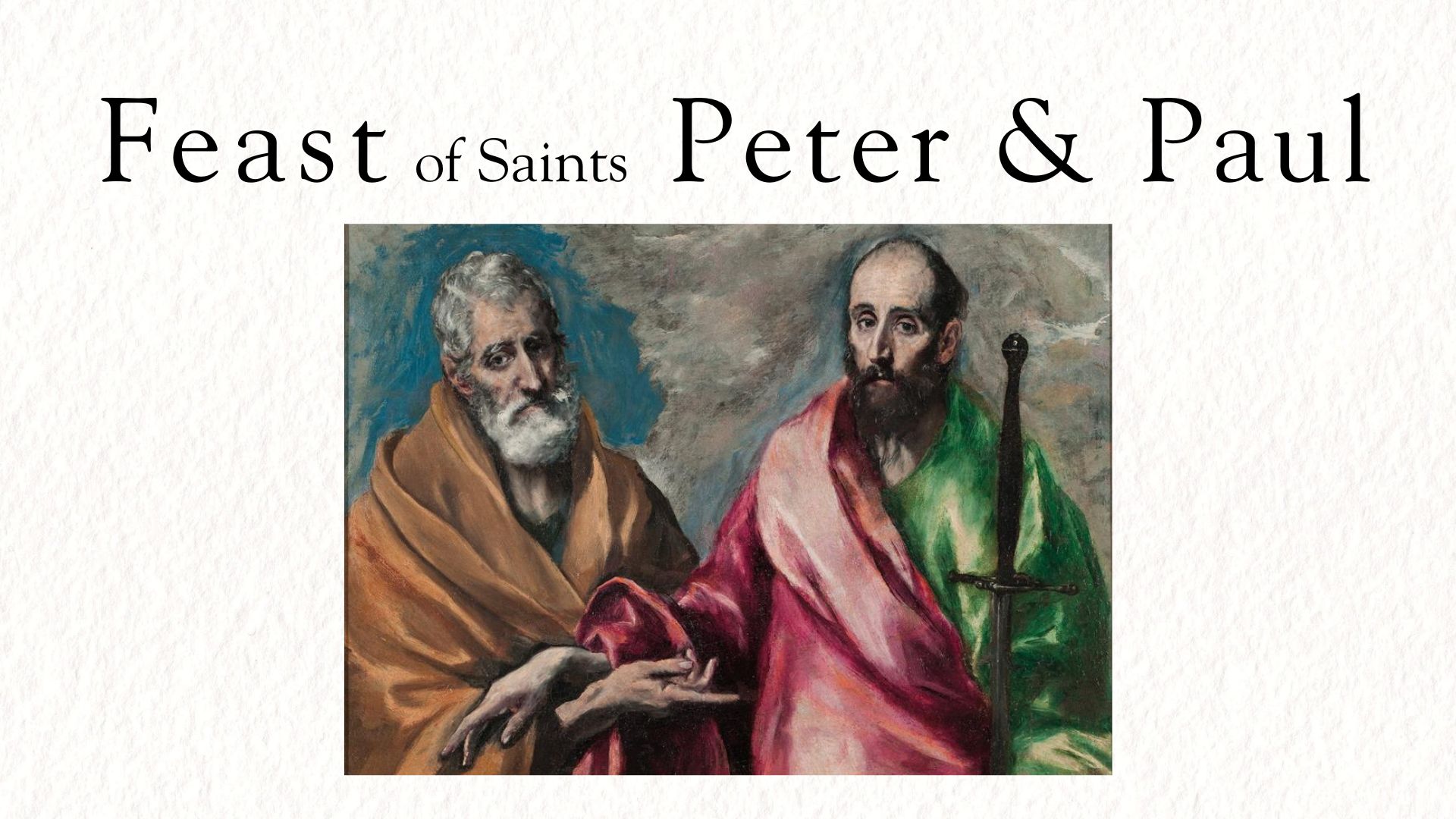
The Feast of Saints Peter and Paul

Matthew 16:18

“You are Peter, and upon this rock I will build my Church.”

Readings for Sunday: Acts, 2 Timothy, Matthew

Reflection:

This Sunday, we celebrate the two great evangelizers of our faith—St. Peter, the apostle to the Jews, and St. Paul, the apostle to the gentiles. Though very different in background and personality, both were chosen by Christ and gave their lives to build His Church. The readings for today offer us a powerful reminder of who they were, what they endured, and what their lives mean for us.

In our first reading, from the Acts of the Apostles, Peter is imprisoned for preaching the Gospel. An angel of the Lord comes, light fills the cell, and Peter walks free. God isn’t done with him yet. It’s a reminder that when we follow Christ, no prison—physical or spiritual—can hold us back.

Next, in Paul’s second letter to Timothy, we read the apostle’s words: “I have fought the good fight, I have finished the race, I have kept the faith.” What a testimony! Paul’s life wasn’t easy—he was beaten, shipwrecked, and imprisoned—but he never gave up. And through it all, he trusted that the Lord would see him through.

Finally, in today’s Gospel from Matthew, we hear that it is Peter, who answers, “You are the Christ, the Son of the living God.” Jesus responds with those unforgettable words: “You are Peter, and upon this rock I will build my Church.”

This isn’t just about Peter personally—it’s about the Church’s foundation. Jesus entrusts Peter with leadership, showing us how God works through human instruments to guide His people.

Peter and Paul weren’t perfect; both would admit that they were sinners. Paul originally persecuted members of the Church and Peter denied Jesus three times before the crucifixion. But grace transformed them—and through them, the world. Their lives encourage us to say “yes” to Jesus, no matter our past, and to trust that God can do great things through each of us.

Let us pray today for their courage, their faith, and their love for Christ. May we, like Peter and Paul, become living stones in the Church that the Father continues to build—in and through Christ, our Lord.

Reflection Questions

  • In Your Prayer Ask: How is God calling me to be a “rock” in my own community, like Peter was for the early Church?

  • Reflect on This: What are the “chains” in my life that might be holding me back from fully following Christ?

  • Consider in Quiet Reflection: Like Paul, can I say I am “fighting the good fight” and “keeping the faith”?

Corpus Christi Sunday

1 Corinthians 11:23-26

"This is my body that is for you. Do this in remembrance of me."

Readings for Corpus Christi Sunday: Genesis, 1st Corinthians, Luke

Reflection:

If you go to an evangelical or mainline Protestant church, you probably will not see what you see in Catholic Church: communion every day. Some of those churches only have communion on Sundays, some only once in a great while. And if you ask them, what is communion, they will generally tell you it is bread and wine that reminds us of Jesus and what he has done for us.

So what is with us Catholics? In English, when we hear Jesus say, “Do this in remembrance of me,” we often think of a simple mental recollection. But the New Testament is written in Koine Greek. The usual word for “remember” is mimneskomai, which is similar to our English word, evoking the concept of a mental connection. However, the word Jesus actually used was anamnesis. This Greek word is more unusual, and means that, by recalling (God’s) action of the past, it becomes present here and now. Thus, by repeating Jesus’ words and actions, the bread and wine become Jesus himself here and now.

At the Last Supper—celebrated during Passover—Jesus connected His sacrifice on the cross to the ancient deliverance of Israel from slavery in Egypt. Just as the Israelites had to eat the Passover lamb to partake in God’s salvation, so too we must partake of the true Lamb of God, Jesus Christ, who takes away the sins of the world. We describe our participation in the sacrifice of Christ for our salvation through the word transubstantiation: the substance of bread and wine truly becomes the Body, Blood, Soul, and Divinity of Christ, though the appearance of bread and wine remains the same.

So why wouldn’t we have Communion every day? If Christ Himself becomes present to offer salvation, to nourish us for eternal life, and to unite us to His sacrifice—how could we not?

Reflection Questions

  • What does it mean to you personally that, through anamnesis, Christ’s sacrifice becomes present at every Mass, rather than just being a memory?
  • How does understanding the Eucharist as truly Christ’s Body and Blood — through transubstantiation — change the way you approach receiving Communion?
  • If the Eucharist is the ongoing gift of Christ’s saving presence, how might you deepen your devotion to the Mass and make it a greater priority in your life?

Trinity Sunday

John 16:13

[The spirit] will guide you to all truth.

Readings for Trinity Sunday: Proverbs, Romans, John

Reflection:

A human rights lawyer once described her conversion from Judaism to Catholicism with a single, striking line: “One day, I figured out that God is love, so I had to convert.” This simple declaration carries profound meaning. To say that “God loves,” is to speak of what God does. To say that “God is love,” refers to what He is. God is love in himself. Even if God had never created the angels, humans or anything else, God was, is and will always be love.

Love, by definition, requires more than one person. Thus, if God is love in Himself, there must be, within God, a relationship – a communion of persons. This is the mystery of the Trinity: one God, three persons – Father, Son, and Holy Spirit – eternally. To paraphrase St. Augustine: God is the lover (Father) the beloved (Son) and the bond of love they share (Holy Spirit).

Sometimes, people misunderstand what the Church teaches in terms of the Trinity. Some imagine that the Trinity is really three gods huddling close together. Others fall into modalism – believing one person merely acts in three different ways or modes.

In the end, we will struggle to fully understand God as Trinity because God is infinite, and we are not. The idea of one God in three persons is not irrational, but suprarational; it exceeds the ability of our finite minds to understand.

For that reason, we say the Trinity (God) is a mystery. For us, a “mystery” is not a problem to be solved or a whodunit. It is a reality so profound and deep that we can never completely understand.  God is love, and while we can understand a lot, there is always so much more, to the point that we can spend forever in heaven knowing God better and better, and yet there will always be more.

Reflection Questions

  • What does it mean for God to be love, not just in action but in His very being? How does this shape one’s understanding of the Trinity?

  • If God is love, then what does this tell me about why he created the universe, and me?

  • If God is love, what should my life on earth look like?  What should my priorities be?  What is heaven really like?

Pentecost Sunday

John 14:15

If you love me, you will keep my commandments.

Readings for Pentecost Sunday (during the day): Acts, Romans, John

Reflection:

Have you ever wondered why we call ourselves Catholic Christians? We read in the book of the Acts of Apostles in the Bible: “Then he (Barnabas) went to Tarsus to look for Saul, and when he had found him he brought him to Antioch. For a whole year they met with the church and taught a large number of people, and it was in Antioch that the disciples were first called Christians.” A Christian is one who believes in Jesus, the God-man, who saves the world by his passion, death, and resurrection. A Christian believes that Jesus is the Son, who teaches us about the Father and the Holy Spirit; one God in three persons.

It is again from Antioch that we received the second part of our name. St. Ignatius of Antioch, writing in 107AD, spoke of the Church as “Catholic,” specifically with the Greek word katholicos, meaning “universal.” The Church is for everyone, Jews and Greeks/gentiles. It doesn’t matter from which country or people you come; God calls everyone to belong to himself in Christ Jesus.

As far as the word “Church” is concerned, it is Greek, ekklesia, meaning “(those) called out of.” The Church is comprised of Jews and gentiles: those called out of sin and death into life, those called out of darkness into light.

That is why in today’s second reading, St. Paul reminds us that, “[I]n one Spirit we were all baptized into one body,
whether Jews or Greeks, slaves or free persons,
and we were all given to drink of one Spirit.” The new covenant that Jesus established opened the doors of salvation to the whole world. Pentecost is when the mission truly began. The Holy Spirit descended upon the apostles, empowering them to speak in many languages and boldly proclaim the Gospel. People from all nations understood them, a clear sign that the Church was for everyone. Today, the Catholic Church continues this mission. With over a billion members worldwide, we are still one body in Christ.

Reflection Questions

  • What does it mean to you personally that the Catholic Church is “universal” and open to all people, regardless of background or nationality?
  • In what ways can you, like the apostles at Pentecost, be bold in sharing your faith with others today?
  • How does understanding the origins and mission of the Catholic Church help you grow in your relationship with Christ and the larger Christian community?

Ascension of the Lord

Luke 24:48

You are witnesses of these things.

Readings for the Ascension of the Lord: Acts, Hebrews, Luke

Reflection:

“All the world’s a stage, and all the men and women merely players,” wrote Shakespeare. While he may have meant it metaphorically, there is something profoundly true in that statement—especially when we speak of the drama of salvation.

This divine drama isn’t make-believe; it is the true story of history—our relationship with God unfolding across time. God built the stage—our universe—and placed us, real people, into His story. From the beginning, He desired a relationship with us. But the devil sought to disrupt this divine play by tempting humanity into sin.

Yet the most remarkable twist in this drama came when God Himself took the stage. In Jesus Christ, God entered history. By His death and resurrection, He restored what was broken. The drama could now continue. But surprisingly, Jesus didn’t stay on stage.

His Ascension wasn’t an exit, but an invitation—for us to step into His role. The Church, His body, now carries on His mission.

Had Jesus remained visibly among us, we might have only sat at His feet. Instead, He ascended so we might rise, filled with the Holy Spirit, to be “little Christs”—active in the world, continuing His work.

But the drama isn’t over. As the angels told the apostles, Jesus will return. The story ends when the Church, transformed and united in love, gathers around Him once more. Until then, the curtain remains open—and we each have a role to play.

So, remember: the drama of salvation is still unfolding—and you are part of it.

Reflection Questions

  • What role do you see yourself playing in the drama of salvation, and how might God be inviting you to step more fully into that role?
  • Why do you think Jesus chose to ascend and leave the stage rather than remain physically present, and how does that change your understanding of the Church’s mission today?
  • In what ways can you respond to the promptings of the Holy Spirit in your daily life to grow closer to God and others?

Sixth Sunday of Easter

John 14:24

“Whoever loves me will keep my word, and my Father will love him, and we will come to him and make our dwelling with him."

Sixth Sunday of Easter Readings: Acts, Revelation, John

Reflection:

Our readings for this Sunday reveal the radical, countercultural call of Christianity: to live in love and peace—not the superficial kind, but the real, gritty, divine kind. If being a hippie is about love and peace, then Catholics, through Christ, are the uber hippies. But not by the world’s definition. Jesus redefines love as agape – self-giving, sacrificial, faithful action. Not just emotions or romance. As Jesus says, “Whoever loves me will keep my word,” love is obedience rooted in relationship. To love Jesus means choosing daily discipleship – intentional actions, sacrifices, and the humility to love even when we don’t feel like it.

This love leads to peace – but again, not the world’s shallow version of peace, as in the absence of conflict or a detente. Without addressing underlying issues, such absences quickly end in renewed conflicts.  The Hebrew word for peace is shalom; it means right relationship, right relationship with God, with oneself, and with others. When there are right relationships all around, then there is true and lasting peace. Jesus is the source of true peace because He is the reconciliation between heaven and earth.

In the second reading’s vision of the heavenly city, there’s no temple because God and the Lamb dwell with the people. All is in right relationship – perfect peace.

Being Catholic, then, means living out this divine love and peace in a world that worships idols: comfort, consumerism, and self. True discipleship is countercultural. It’s resisting gossip, greed, and indifference. It’s why we gather on Sundays, why we sacrifice, why people should sense something different – right relationship – when they encounter the people of St. James Parish. Discipleship isn’t a trend. It’s a revolution of love. In Christ, we are called not to blend in, but to stand out – as the true lovers and peacemakers of the world.

Reflection Questions

  • How do I actively live out love as an intentional action in my daily life, especially when it’s difficult or inconvenient?
  • What areas of my life are not in “right relationship” with God or others, and how might Jesus be calling me to restore peace there?
  • In what ways am I called to be countercultural as a disciple of Jesus, and how can I more boldly reflect His love and peace in a world that often values the opposite?

Fifth Sunday of Easter

John 13:34

"I give you a new commandment: love one another. As I have loved you, so you also should love one another."

Fifth Sunday of Easter Readings: Acts, Revelation, John

Reflection:

In this Sunday’s Gospel (John 13:31–35), Jesus commands His disciples to love one another as He has loved them. This is not ordinary love like philos (friendship), eros (romantic), or storge (familial bond), but agape — the self-giving love manifested on the cross. It is on the cross, surprisingly, that Jesus’ glory is revealed. We usually imagine glory with trumpets, light, maybe angel choirs; yet Christ shows divine glory through suffering and sacrifice. The cross, which during the 1st century was a sign of humiliation and defeat, became the sign of ultimate victory, revealing God’s true nature: God is love.

This deep love must now be manifested in the Church. In Acts 14:21–27, Paul and Barnabas return to the communities they served, strengthening them and sharing what God had done through them.

The Church is not a club or a social organization; it is the living Body of Christ, called to embody Christ’s love and glory for the world to see.

Jesus commands not that we “like” one another, but that we love, willing the good of the other, even when it is difficult. We often fail at this, and the world notices when we do. At St. James (and beyond), we must ask: How well do we love one another? Are we willing to serve, to sacrifice, to refrain from gossip or criticism? True love, revealed on the cross, is what marks us as His disciples and shows the world who God really is: a Trinity of self-emptying love.

Reflection Questions

  • In what ways am I being called to show Christ-like, self-sacrificial love to those around me — especially those I may not naturally “like”?
  • Do I see the Cross as a place of glory — not just suffering — and what does that reveal to me about who God is and how I’m called to live?
  • How well does my participation in the Church — in community, service, and relationships — reflect the love and unity of the Body of Christ?

Fourth Sunday of Easter

John 10:27-28

“My sheep hear my voice I know them, and they follow me. I give them eternal life, and they shall never perish.”

Fourth Sunday of Easter Readings: Acts, Revelation, John

Reflection:

Our readings for this Sunday evoke a rich image of God as the Good Shepherd. Early Christians embraced this compelling figure in contrast to the images of pagan gods – immortal “super humans” who were known more for their incredible power than their compassion for humanity. The incarnation enabled a different image of God who lovingly guides, protects, and sustains His people.

The Psalms call us to contemplation and to joyful worship, declaring that “we are His people, the sheep of His pasture.” This reminds us that, like sheep, we need care, direction, and protection. Sheep are known for their tendency to wander and their need for guidance—just as we, too, often stray or become lost without the structure and wisdom of God’s Word. God’s rules are not burdens, but paths to life, keeping us safe and close to Him.

That is why Jesus says in the Gospel, “My sheep hear my voice I know them, and they follow me. I give them eternal life, and they shall never perish.” As the Good Shepherd, He leads us not with force, but with love and trust. His voice calls us to follow, and His guidance offers peace, even in a chaotic world.

In following God’s ways, we discover not just order, but joy, security, and the promise of eternal life.

Reflection Questions

  • In what areas of your life do you feel like a “wandering sheep,” and how might listening to the Good Shepherd’s voice help guide you back?
  • How do God’s rules and guidance provide not just structure, but freedom and peace in your daily life?
  • What does it mean to you personally that Jesus, the Good Shepherd, promises eternal care and comfort, even beyond this life?

Third Sunday of Easter

John 21:17

"Feed my sheep."

Third Sunday of Easter Readings: Acts, Revelation, John

Reflection:

Today’s readings form a “before and after” picture of St. Peter. Peter’s transformation, as depicted in today’s readings, reveals the profound impact of his encounters with Jesus.

The image of “after” is evident in today’s first reading from Acts. Peter, once afraid to admit he knew Jesus, now boldly proclaims Him before the Sanhedrin, the very authorities who could have him killed. He declares, “We must obey God rather than men,” showing a fearless commitment to Christ. He and the other apostles rejoice for being considered worthy to suffer for Jesus’ name.

Whereas before, in John’s Passion narrative we see Peter at a low point—fearful and ashamed. When questioned by a servant girl, he denies knowing Jesus. He in fact ends up denying the Lord three times prior to the crucifixion. These denials highlight Peter’s weakness and fear of persecution, despite his earlier promises of loyalty.

What caused this dramatic change – how did Peter become St. Peter, “the rock?” In today’s Gospel reading (John 21:1-19), after Jesus’ resurrection, Peter is given the opportunity to redeem himself. The risen Jesus gently confronts him by asking three times, “Do you love me?”—mirroring Peter’s three denials.

Each affirmation by Peter is followed by Jesus’ command to “feed my sheep,” symbolizing his restored calling. This intimate moment not only forgives Peter but commissions him anew, transforming his shame into purpose.

Peter’s journey from denial to courageous witness underscores the power of grace, forgiveness, and transformation. Through his encounter with the risen Jesus, Peter moves from fear to faith, from failure to leadership. May we all, like St. Peter, receive the grace to have courage for Christ.

Reflection Questions

  • How does Peter’s journey from denial to bold witness inspire you in your own moments of weakness or fear?
  • In what ways has an encounter with Jesus—through prayer, Scripture, or life experience—brought about transformation in your life?
  • What does Jesus’ forgiveness and commissioning of Peter teach us about God’s grace and our own ability to start again after failure?
Join us for our Mass livestream Watch Online