All Posts By

admin

St. James School Principal

ST. JAMES PARISH – ARLINGTON HEIGHTS, IL
ST. JAMES SCHOOL PRINCIPAL

If you are interested in this position and want to learn more contact Kelly Busa: [email protected]

The Archdiocese of Chicago Catholic schools serve more than 40,000 students in 150+ elementary and high schools in Cook and Lake counties. It is one of the largest private school systems in the United States. Its schools have received 96 Blue Ribbon awards from the U.S. Department of Education over the past 10 years.

The elementary school principal is hired by and is accountable to the pastor or the Jurisic person for the operation of the school. The principal is expected to abide by the established policies and procedures of the Archdiocese of Chicago, the Office of Catholic Schools, and the directives of the Superintendent of Catholic Schools. The principal participates in the annual performance review outlined by the Office of Catholic Schools.

Catholic Identity

  • Promotes and facilitates an environment which fosters the Catholic identity of the school
  • Ensures that the faculty is current in the areas of theology, religious education and catechetical skills
  • Promulgates and periodically revises the school mission statement and philosophy in collaboration with the school community
  • Encourages and educates students, school families and faculty member to celebrate liturgies, including Sunday Mass, and the season/feasts of the liturgical year
  • Promotes parent/guardian partnerships in advancing the mission of the school and the ministry of the Catholic education

Academic Excellence

  • Ensures all students learn to their fullest potential, using data to inform decision-making
  • Supervises implementation of the Office of Catholic Schools curricula in a rigorous, relevant, and age-appropriate manner that develops students’ ability to continually succeed
  • Assists faculty in utilizing effective learning strategies that integrate technology
  • Acts as the instructional leader of the school by recruiting, hiring, supervising, evaluating, and providing quality professional development for highly qualified, certified staff members to improve student learning

School Viability

  • Serves as the executive officer to the board, helping to prepare for meetings, informing them of policy, and leading their continual professional development and goal setting
  • Collaboratively develops and successfully implements strategic planning that involves representatives of all stakeholders of the school and wider community
  • Prepares the annual school budget in cooperation with the board and parish
  • Monitors the budget and finances to ensure proper cash flow with diverse funding sources to support the financial stability of the school
  • Provides for regular review of financial statements by the pastor/Jurisic person and board to ensure awareness of the financial position of the school and makes necessary adjustments for financial viability
  • Promulgates written local financial policies and procedures for collection and disbursement of all school funds based on Archdiocesan best practices and ensures their proper implementation
  • Stabilizes and/or grows enrollment to reach full capacity of the school by implementing an enrollment management plan, overseeing an enrollment management team, and conducting an annual appeal to provide for scholarships/programs
  • Ensures the maintenance and safety of the school plant according to local, state, Archdiocesan and the Office of Catholic Schools policies, procedures, and directives

General Administration

  • Designs and implements communication strategies to ensure that the pastor /Jurisic, staff, parish school families, prospective families, and the community are informed about school matters and engaged in the school
  • Develops appropriate handbooks for school families and school staff
  • Works with the board to successfully complete school and system goals
  • Utilizes teacher teams and shared leadership to delegate responsibilities
  • Develops an organized work environment and adheres to deadlines and requests
  • Oversees discipline in a respectful, proactive way according to Archdiocesan policy
  • Maintains professional, working relationships with all members of the school community and involves them in the decision-making process of the school where appropriate
  • Identifies, encourages, and mentors future school leaders
  • Maintains accurate local files and records for each student and employee
  • Attends required Archdiocesan, Office of Catholic Schools and local meetings
  • Implements conflict management procedures as necessary
  • Promotes a culture of respect for each member of the community
  • Oversees co-curricular activities (extended school day, sports, activity clubs) ensuring that the programs are in compliance with local and Archdiocesan policies
  • The principal is expected to supervise and evaluate staff and student progress and school safety through regular site visits to the classrooms and all other areas of the school plant.

Dates of employment: July 1st through June 30th of the school year, with attendance of all July meetings a requirement.

Qualifications

Education

Required
Masters or better in Education/Administration or related field.

Experience

Required
Must be Catholic

Preferred
3 years: Professional experience in a Catholic School

Licenses & Certifications
Required
Administrator License

If you are interested in this position and want to learn more contact Kelly Busa: [email protected]

Palm Sunday

Philippians 2:7-8

He emptied himself, taking the form of a slave, coming in human likeness; and found human in appearance, he humbled himself, becoming obedient to the point of death, even death on a cross.

Full Palm Sunday Readings: Isaiah, Philippians, Mark

Reflection:

Christ Jesus, though he was in the form of God, did not regard equality with God something to be grasped. Rather, He emptied himself, taking the form of a slave, coming in human likeness; and found human in appearance, he humbled himself, becoming obedient to the point of death, even death on a cross. – Philippians 2:6-7

St. Paul, in his letter to the Philippians, chapter 2, presents the “Philippians Hymn.” This scripture is a moving description of Jesus’ humility in willingly sacrificing his own life out of great love. The concept of “emptying” (in Greek: kenosis) is understood as Jesus willingly laying aside his divine power. Dr. David Campbell wrote, “Jesus, the god-man, was fully divine, but veiled his glory to accomplish his mission – and prove humans could fulfill the Law of God with the help of the Holy Spirit and a commitment to faithfulness.”

This is the mystery we walk through this Holy Week, beginning with the reading of the Passion today.

Meditating on the sorrowful mysteries of the Rosary – the Agony in the Garden of Gethsemane, the Scourging at the Pillar, the Crowning with Thorns, the Carrying of the Cross, and the Crucifixion – can help us to be united with Jesus as he endures his Passion. But his seemingly humiliating death is not the end.

The Philippians Hymn concludes with: Because of this, God greatly exalted him and bestowed on him the name which is above every name, that at the name of Jesus every knee should bend, of those in heaven and on earth and under the earth, and every tongue confess that Jesus Christ is Lord, to the glory of God the Father. – Philippians 2:8-11

The one who was brutally executed has conquered death itself in his glorious Resurrection. God bless you this Holy Week.

- Fr. Ed

Reflection

  • How does Jesus’ willingness to undergo suffering and death out of love for you deepen your understanding of God’s love?
  • In what areas of your life do you struggle to “empty yourself” and let go of control, trusting in God’s plan for you?
  • As we enter Holy Week, how can you make more time for prayer and reflection to be united with Jesus in his Passion?

Director of Evangelization and Formation

ST. JAMES PARISH – ARLINGTON HEIGHTS, IL
DIRECTOR OF EVANGELIZATION AND FORMATION

Position Type: Full Time

Department: Formation + Evangelization

Under the direction of the pastor, the Director of Evangelization and Formation provides leadership and oversight for Religious Education, Youth Discipleship and Evangelization, FOCUS Parish Outreach, and other efforts associated with evangelization and faith formation. This includes pastoral planning and needs assessment regarding evangelization and faith formation for the parish and school. The Director supports, accompanies, and equips the leaders in parish ministerial areas to focus their attention beyond parishioners and into the community at large.

RESPONSIBILITIES

  • Collaborates with the Pastor and other Pastoral Team members on discerning the vision that best enables the parish to offer ways for all parishioners to practice missionary discipleship.
  • Develops strategies and methods to help integrate new members into parish ministries and parish life overall.
  • Provides direct management and leadership for staff who direct Religious Education, Youth Discipleship and Evangelization, FOCUS Parish Outreach, as well as lay leaders who coordinate faith formation programs, such as RCIA.
  • Assists those who coordinate the parish ministries to help them align the vision of their specific ministries to the parish vision and develop teamwork that will support these efforts.
  • Develops an annual budget for the pastoral ministries that provide for parish vitality and evangelization in collaboration with the Controller.

QUALIFICATIONS AND EDUCATION REQUIREMENTS

  • Seven to ten years of experience in evangelization and/or faith formation working within a parish or religious organization.
  • Bachelors or Masters’ degree in Theology; religious education or related field and/or experience in parish catechetical ministry; Archdiocesan Catechist Certification; Protecting God’s Children trained.
  • Demonstrated success in leading and managing teams with a strong commitment to collaboration and teamwork among the clergy, staff, volunteers, groupings, and the Archdiocese of Chicago.
  • Technology, social media, and computer literacy.
  • Practicing Catholic with a solid grounding in Catholic identity and the faith tradition.
  • An evangelizer, yourself, who can share experiences of “being a disciple, and making disciples” in line with our parish mission statement.
  • Able to maintain a healthy lifestyle and a reasonable balance among the legitimate claims of family, community, personal relationships, and ministry, and possess the ability to be sensitive to the realities of parish life as it is lived in our community.
  • A change maker, who can ascertain the future needs of ministries, develop plans, match resources to the needs, and implement.

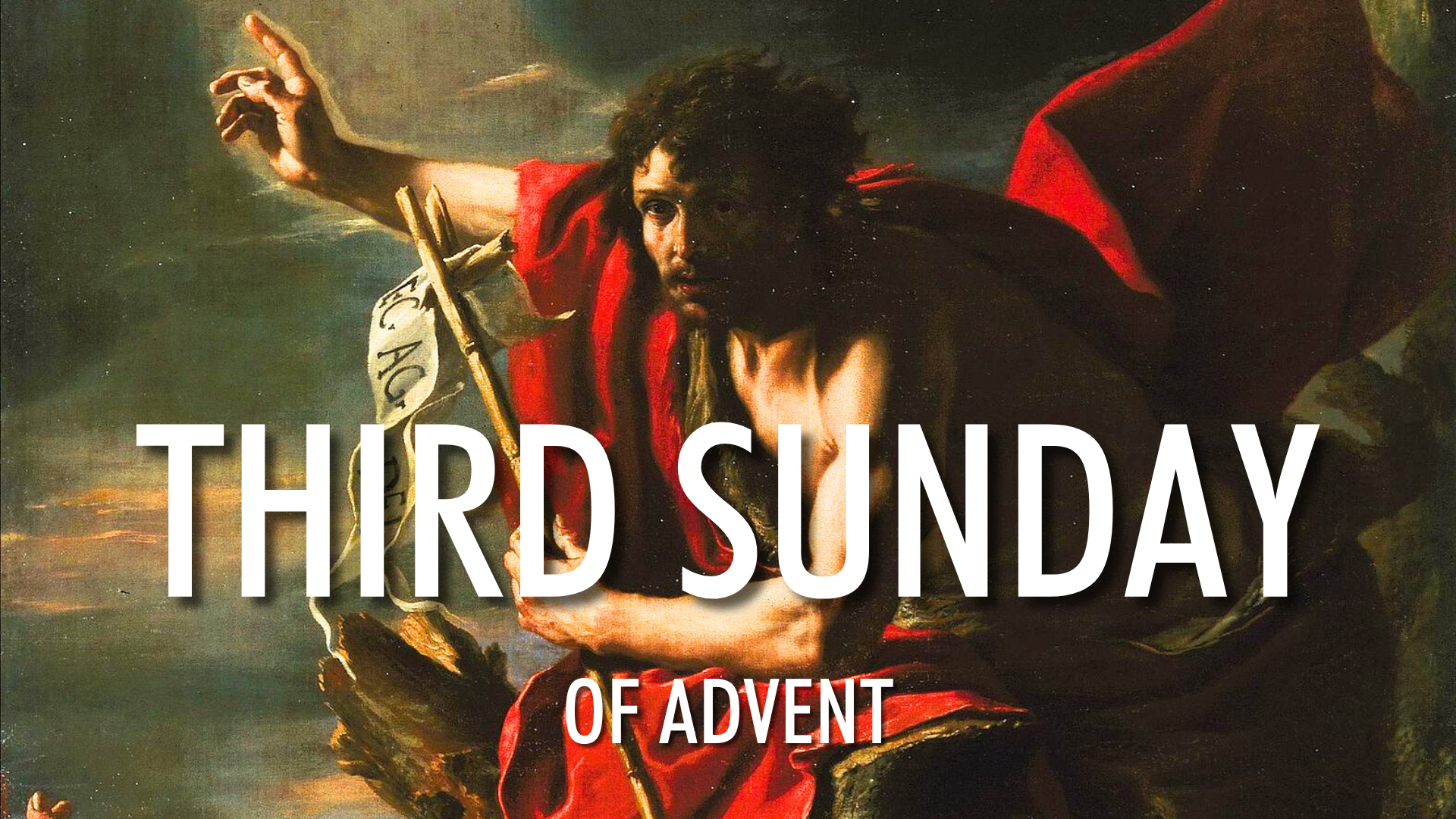
Third Sunday of Advent

John 1:23

I am the voice of one crying out in the desert,
‘make straight the way of the Lord

Full Gospel Passage: John 1:6-8, 19-28

In today’s gospel reading, the “Jews from Jerusalem sent priests and Levites” to ask John the Baptist, “Who are you?” Didn’t they know he was John the Baptist?

They knew his name but wanted to know if he was one of the three persons whose arrival they were anticipating. In the first century AD, the Jewish people expected:

  • A Davidic messiah figure, the Christos, to fulfill God’s promise to King David that one of his descendants would always sit on the throne (2 Sam 7:11-13): (2 Sam 7:11-13): “Moreover, the LORD also declares to you that the LORD will make a house for you: when your days have been completed and you rest with your ancestors, I will raise up your offspring after you, sprung from your loins, and I will establish his kingdom. He it is who shall build a house for my name, and I will establish his royal throne forever.”
  • That Elijah (who never died but was taken up into heaven in a chariot of fire – 2 Kings 2:11) would come back and prepare the way for the Messiah (Malakai 4:5): “See, I am sending you Elijah the prophet before the day of the Lord comes, that great day, greatly to be feared.”
  • There will be a prophet like Moses who will explain and clarify the law (Deuteronomy 18:15-18): “A prophet like me will the LORD, your God, raise up for you from among your own kindred; that is the one to whom you shall listen… I will raise up for them a prophet like you from among their kindred, and will put my words into the mouth of the prophet; the prophet shall tell them all that I command.”

While John was not the messiah/Christ, Elijah, or the prophet, Jesus identified him as a figure like Elijah (Matt 11:14), preparing the way of the Lord.

- Fr. Paul Stein

Reflection

  • Amidst Advent’s anticipation, do you approach prayer with openness to the unexpected ways God acts? How can this expectancy deepen your connection with Him?
  • Reflecting on John’s preparation, how might your Advent prayer create space for Christ’s presence, shaping a welcoming heart for His arrival?

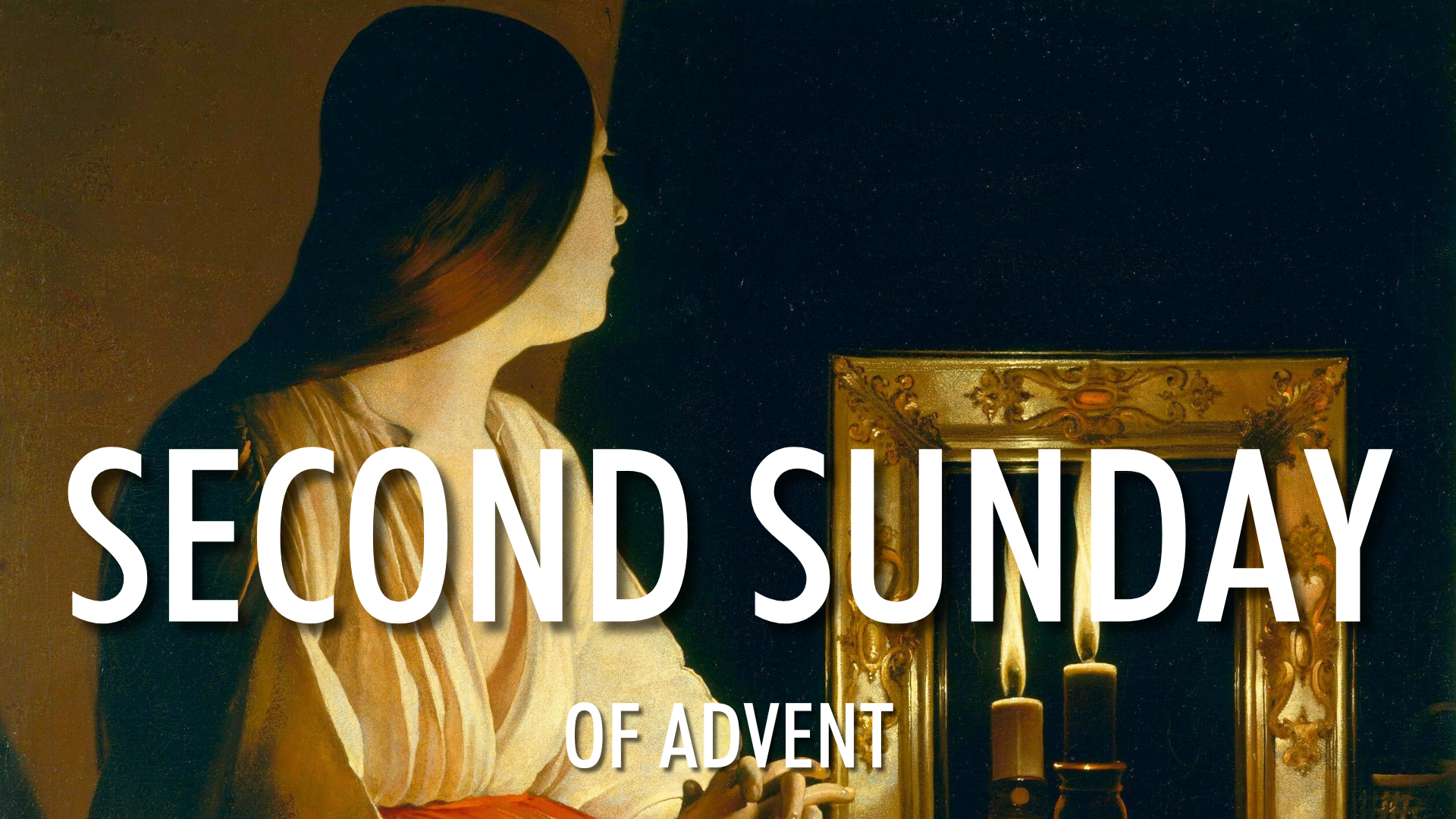
Second Sunday of Advent

2 PETER 3:9

The Lord does not delay his promise, as some regard “delay,” but he is patient with you, not wishing that any should perish but that all should come to repentance

Full Gospel Passage: Mark 1:1-8

“The Lord does not delay his promise, as some regard “delay,” but he is patient with you, not wishing that any should perish but that all should come to repentance.” (2 Peter 3:9).

Peter reminds us of the important meaning of this time of repentance and preparation, the season of Advent; firstly, the Lord’s desire for us, and secondly, our interior disposition as we prepare.

The Prophet Isaiah uses very earthy language which can be applied to our hearts: “In the desert prepare the way of the LORD! Make straight in the wasteland a highway for our God! Every valley shall be filled in, every mountain and hill shall be made low; the rugged land shall be made a plain, the rough country, a broad valley.”  (Isaiah 40:3).

Confession is a fruitful way to prepare for both Christmas and the Second Coming of the Lord. There is a necessary humility in confessing our sins in the sacrament, but a powerful grace comes in a good confession. It is the opportunity to make a fresh start and receive the Lord’s abundant forgiveness. There’s a scene in John Powers’ delightful novel about growing up Catholic in the 1950s Do Black Patent Leather Shoes Really Reflect up? in which the author leaves church and returns home after going to confession. In his head, he hears these joyful words – Free from sin! Free from sin! Free from sin!

- Fr. Ed Pelrine

Reflection

  • How will you actively align your Advent with the Lord’s patience and desire for repentance (2 Peter 3:9)? Take a specific step, like praying in adoration, today to foster repentance and preparation recognizing it as a key aspect of this season.
  • What concrete action can you commit to experiencing the grace of confession? Consider going to confession at St. James on Thursdays and Saturdays, or scheduling a confession as a tangible step towards a renewed spiritual journey this Advent.

First Sunday of Advent

MARK 13:33

Be watchful! Be alert! You do not know when the time will come.

Full Gospel Passage: Mark 13:33-37

Can you believe it? It is only 21 days until Christmas; so much to do, so little time. Thank God Amazon delivers. While Advent is a busy time in which we prepare for Christmas by cleaning, decorating, and shopping, perhaps we should also prepare… just in case Jesus comes back. Can you imagine Christmas morning, Jesus knocking on your door and saying: “I heard you are having a party for my birthday, mind if I join you?” While it may seem far-fetched, we truly don’t know when Jesus is coming back.

He tells us in today’s gospel: “You do not know when the time will come.” If Jesus did come, would we wish that we had more time to prepare? More time to volunteer, more time to help our neighbor, more time to pray, read the bible… anything to prepare for his coming? I doubt we would wish that we had watched more episodes of our favorite TV show or YouTube and TikTok videos. I bet we would wish that we had given Jesus more of our time. We can start by giving our time here at St. James.

- Fr. Paul Stein

Reflection

  • In the midst of the Christmas bustle, what specific actions or changes can you incorporate into your daily routine to ensure that you are allocating meaningful time to volunteer, help your neighbor, and engage in prayer or scripture to grow your relationship with Jesus?
  • Reflecting on Jesus’ return, what adjustments can you make in your priorities to align more closely with what you would value if Jesus were to arrive unexpectedly, such as dedicating more time to prayer, reading the Bible, and serving your community?

Thirty-Third Sunday in Ordinary Time

MATTHEW 25:21

Well done, my good and faithful servant.

Full Gospel Passage: Matthew 25:14-30

In the parable of the talents from Matthew chapter 25, we hear the familiar lesson from Jesus about the master who gives his talents (money) to three of his servants. He gave them responsibility over very large amounts of money. Two of the servants were good and prudent stewards who invested the money, but the third buried his treasure out of fear. We are all given treasures by God, who may be asking us through this parable to seriously consider what we are doing with that gift.

Time, talent, and treasure are abundant gifts from a generous God. What does our stewardship look like? Are we imitating God’s generosity in building up others and the Church?

- Fr. Ed Pelrine

Prayer for Reflection

Lord Jesus, teach me to be generous. Teach me to serve as you deserve, To give and not to count the cost, To fight and not to heed the wounds, To labor and not to seek to rest, To give of my self and not ask for a reward, Except the reward of knowing that I am doing your will.

- St. Ignatius of Loyola

Thirty-Second Sunday in Ordinary Time

MATTHEW 25:13

Stay awake, for you know neither the day nor the hour.

Full Gospel Passage: Matthew 25:1-13

I remember the shock: it was 1995 and I was in college. A classmate with whom I had many classes in high school died at the age of 20. When you are young, you think you are going to live forever; as you get older, you realize time goes quicker than you think. Jesus’ words are just as true today as they were back then: “Stay awake, for you know neither the day nor the hour.” When I come before the Lord at the end of my life – which could be any day – what will I tell him that I did with all the earthen treasures that he entrusted to my care?

After all, he created the world; everything ultimately belongs to him. Did I freely and gladly return to him what is already his? Did I give of my treasure to the poor and to the Church? It is one thing to bequeath my money after I die and it is no longer any good to me, it is another to lovingly give it away now. I hope to love Jesus intensely now by giving back my treasure so that I may ultimately have treasure in heaven.

- Fr. Paul Stein

Reflection

  • How am I presently stewarding the earthly treasures entrusted to me by God, considering the transient nature of life?
  • How can I more actively share my treasures with the needy and support the Church, embodying a spirit of selfless generosity in the present?

Thirty-first Sunday in Ordinary Time

MATTHEW 23:10

You shall love the Lord, your God, with all your heart, with all your soul, and with all your mind.

Full Gospel Passage: Matthew 23:1-12

We read today Christ rebuking the Pharisees and the practice of their priestly work for the gratification of themselves to be seen by others as being holy. They took the opportunity to show their piousness by expanding their phylacteries (small leather pouch or box that carried the law) and lengthening their tassels. They wore the façade of holiness yet were all too eager to accept places of honor at banquets, seats of honor in synagogues, greetings in marketplaces, and the salutation ‘Rabbi.’ They were not living their purpose to shepherd the people of Israel back to God but expand their influence and status, as well as their material comfort and benefit. As a result, there were factions within the Jewish community that purported to know the fullness of the law and that if the Jewish people wanted to be truly faithful they should follow them.

Christ shows us how we are to avoid those pitfalls and look to Him and His Church: Call no one on earth your father; you have but one Father in heaven. Do not be called ‘Master’; you have but one master, the Christ. The greatest among you must be your servant. Following Christ and knowing Him personally is what we long for. He is the way the truth and the life and He’s given us a Church that provides us with Sacraments, moments to experience an outward sign of inward graces, to experience Him and His unending love for us. We are called to move towards Him, not to tie ourselves to worldly vices that detract from Him. To move as siblings in Christ building up His church and inviting souls outside the Christian family to join us. The parish today is the primary vehicle we can achieve that, and providing the parish with our talent, treasure, and time and seeing that those three “t’s” belong to God helps us move the mission of the Church forward, to make disciples of all nations.

Reflection

  • When have you placed appearances and worldly recognition ahead of genuine faith and service, as the Pharisees did?
  • How can you invest your time, talents, and resources to strengthen your Christian community and the Church’s mission?
  • In what practical ways can you ensure your material wealth is used to strengthen the Church’s mission and deepen your connection with Christ while avoiding worldly distractions?

Hierarchy is Good

Hierarchy is Good

Fr. Paul Stein

So often in today’s culture, we presume that hierarchy is bad: it’s oppressive, unfair, etc. Yet, are not parents hierarchically above their children? Is a mom being oppressive when she insists that her children eat their vegetables? Those hierarchically above can indeed abuse, mistreat, or fail those below them; but does that make hierarchy intrinsically bad? If so, scrap the following: families, civic organizations with their “presidents,” armies, and corporations.[1] Effectively, you would scrap society into anarchy.

Hierarchy is built into creation. You can see it in families, you can see it in mammal behavior. It is also how angels are created. A hierarchy as created by God, is a chain or ladder of persons:

A contemporary reader may wonder if an angel in the lower part of the hierarchy is somehow “less” than an angel higher up in the order. In a sense, no. Granted, angels higher up have more power, but that does imply less dignity or less importance. (H)ieros means holy (a hierus was a priest, a holy one) and archia means to rule. The one above you is empowered by God to elevate you toward him, to lift you up. God empowers or capacitates a hierarchy to look after and be responsible for the one(s) below. Thus, while our guardian angels are “above” us, yet they take care of us.

Hierarchy is built into creation.

… hierarchy is not an oppressive thing, but to the contrary, a responsibility to God and others in the hierarchy. Fans of Spiderman may appreciate the idea that: “with great power comes great responsibility.” This applies to any hierarchy: the military, the family, or the Church. When lived authentically, it is a reflection of the God who took on our humanity in Christ and suffered and died on the cross to save us, in service of humanity. The Church, as the Body of Christ, is supposed to be like a human chain that extends from earth up to heaven, with anyone above, a hierarch, lifting up (the chain) the one below him. Hence, one title of the Pope is the servant of the servants of God.[2]

The Church’s hierarchy is meant for sanctification, raising someone up to heaven. It is true, that the structure would place the pope at the “top,” bishops coming next, then priests, deacons, and then laity.[3] But the Pope is serving faithfully when he is lifting the bishops and everyone else “below.” The purpose of the Pope’s authority is to fulfill his responsibility. For example, Papal Infallibility exercised ex-cathedra – which has only been used twice in history – to provide doctrinal clarity for the sake of salvation.

We can ultimately see the Church’s hierarchical structure in what is above the Pope: Christ himself. “He is the head of the body, the church. He is the beginning, the firstborn from the dead, that in all things he himself might be preeminent. For in him all the fullness was pleased to dwell, and through him to reconcile all things for him, making peace by the blood of his cross” (Col 1:18-20). He is the ultimate “top” of the hierarchy who gave his life to save everyone in the Church. The head of the Church serves all its members.

That is why a bishop’s threefold office to sanctify, teach, and govern – which comes from Christ himself who is priest, prophet, and king – is all aimed at salvation. The bishop is empowered sacramentally through ordination to fulfill these responsibilities. The “power” is not meant for self-service. If the bishop is to be saved, it is through being a faithful shepherd of the flock and father to the people. He cannot even absolve himself from sins, he must go to the sacrament of penance/reconciliation with another bishop or priest!

What This Means For Us

If we spend some time thinking about it, the Church’s hierarchy is ultimately familial. Just as we expect a father to be available to his children even in the middle of the night when they are sick, we expect a priest to be available at all hours of the day to anoint the sick and dying. For a pastor in particular, the responsibility for others and the hierarchical authority as the head of the community are two sides of the same coin. May our family homes be domestic churches where parents exercise their hierarchical authority with great love for their children, being willing to give their lives if necessary for their children.

Footnotes

[1] The Soviet Union, starting in 1918, tried to abolish nuclear families; they had to backtrack, particularly in the Family Code of 1936. The Chinese Communist Party tried abolishing hierarchy in the army (the PLA); in 1988, they wound up reinstituting a system of ranks. Socialism, in essence, is anti-hierarchical; it has never worked out well… and yes, to all those who insist that it hasn’t really been tried: socialism has been tried and it’s a miserable failure.

[2] See the Behold article on The First Hierarchy: Angels.

[3] A clarification: Cardinals are considered clergy of Rome and advisors to the Pope. Most Cardinals are bishops, but not necessarily; the pope has, on occasion, named a priest as a cardinal, though that person is usually beyond voting age for any papal conclave where they elect the next Pope/Bishop of Rome. Religious may be either clergy or laity, depending. A Jesuit priest is both a religious and clergy. A Jesuit brother (not ordained) is religious, but not clergy.

For Further Reading On This Topic

Hierarchy is Good

| Behold-The Church | No Comments
So often in today’s culture, we presume that hierarchy is bad: it’s oppressive, unfair, etc. Yet, are not parents hierarchically above their children? Is a mom being oppressive when she…

The Church Is Family

| Behold-The Church | No Comments
St. Paul, in his letters in the New Testament, often refers to his audience as “brothers” or “brothers and sisters.” Is it hyperbole? Was it the first-century equivalent of “bruh”?…

Can I Start My Own Church?

| Behold-The Church | No Comments
It seems like anybody and everybody is starting their own “church.” You can find them in storefronts and sometimes using a public school gym before they can afford to construct…

The Church Is A Democracy

| Behold-The Church | No Comments
Now and again, the news will report a survey on what Catholics think about a controversial issue inside the Church: divorce and remarriage, women “priests,” abortion, etc. The mainstream media’s…

Join the Behold Newsletter

and receive topics (like the one above)
on Catholicism straight to your inbox!

* indicates required
Join us for our Mass livestream Watch Online