Category

Path To Sunday

12th Sunday In Ordinary Time

Rembrandt | The Storm on the Sea of Galilee

Mark 4:40

"Why are you terrified? Do you not yet have faith?"

Readings for Sunday: Job, 2nd Corinthians, Mark

Reflection:

One of life’s most challenging questions is why God allows suffering. We often ask why God permits cancer, the loss of a child, or personal hardships like losing a job or home. While a complete explanation is complex, today’s Gospel offers us a perspective. Mark 4:35-41 emphasizes that while Christ saves us, God still permits struggles and suffering for our spiritual growth and to deepen our love for Him.

Observing the world’s suffering and injustice suggests a fundamental problem that cannot be resolved merely through education or social programs. Sin, or the rejection of God’s love, has introduced death and suffering into the world.

However, God, through Jesus, has shown His care by experiencing human suffering and death. This act of solidarity and sacrifice is central to salvation, which involves not just escaping hell but also renewing and healing a broken creation.

God permits suffering to foster true love and trust in Him. Through adversity, like the apostles’ fear during a storm calmed by Jesus, we are called to deepen our faith and relationship with God. Ultimately, salvation is about perfecting our love for God and one another, preparing us for eternal happiness in heaven.

Reflection Questions

  • How do you respond to suffering in your life—do you see it as a chance to deepen your faith and trust in God?
  • When facing storms in your life, do you trust that Jesus is with you, calming the chaos?
  • How can you grow in love for God and others through your struggles and challenges?

11th Sunday In Ordinary Time

Mark 4:30

"To what shall we compare the kingdom of God?"

Readings for Sunday: Ezekiel, Second Corinthians, Mark

Reflection:

In Sunday’s readings, we explore the Kingdom of God, a term often used but not always fully understood. Many people equate the Kingdom of God with heaven or an eternal life with God, but often miss its broader implications. Historically, during Jesus’ time, the phrase ‘Kingdom of God’ evoked varied responses. The Sadducees saw it as a shadowy existence, while the Pharisees anticipated a revived Kingdom of Israel led by a messianic descendant of King David.

Jesus, however, presented a different understanding. As King, not merely through earthly descent but as God incarnate, He spoke of a heavenly kingdom that transcends physical space.

It is a state of existence with God, akin to an alternate reality or parallel dimension. This kingdom is also made up of people, described as living stones built into a spiritual house.

Jesus’ teachings indicate that the Kingdom of God is both present and future—it is growing now, through the Church, and will be fully realized in the end times. Our entry into this kingdom is through grace and requires our cooperation. We must live as true citizens of this kingdom, reflecting Jesus’ reign in all aspects of our lives.

Reflection Questions

  • How are you living as a citizen of the Kingdom of God in your daily actions?
  • Is Jesus truly the King over your life, influencing your choices and behaviors?
  • How do you cooperate with God’s grace to grow spiritually?

10th Sunday In Ordinary Time

Mark 3:28

"All sins and all blasphemies that people utter will be forgiven them. But whoever blasphemes against the Holy Spirit will never have forgiveness, but is guilty of an everlasting sin"

Readings for Sunday: Genisis, Second Corinthians, Mark

Reflection:

Many people have wondered what Jesus meant, in the Sunday Gospel reading, when he said: “all sins and all blasphemies that people utter will be forgiven them. But whoever blasphemes against the Holy Spirit will never have forgiveness, but is guilty of an everlasting sin.” God wants our salvation; thus he forgives our sins. The prerequisite for receiving that forgiveness, however, is repentance. Without acknowledging our sins, how can we recognize that we need God’s mercy? Once we have recognized our need, it is then the act of repentance in which we open our hearts to receive that mercy.

If we understand this, then we can understand what Jesus meant. According to Augustine, blasphemy against the Holy Spirit is the refusal to repent. In refusing to repent, one is not only rejecting God’s mercy, and hence will forever be stuck in sin, but also profaning God’s name by making God out to be a liar. It is effectively asserting that I am right, and God is wrong; it is effectively asserting that what he calls sin, I decide to be good (at least for me).

Reflection Questions

  • Where is there still sin in your life? Are you willing to repent, or are you obstinate, justifying yourself?
  • Do you engage in an examination of conscience at the end of every day, recognizing your sins in order to ask for God’s mercy and change your life the next day?
  • Do you seek the illumination of the Holy Spirit to show you the areas of sin in your life that, perhaps, you do not sufficiently recognize?

Easter Sunday

Easter Sunday Readings: Acts, Colossians, John

Reflection:

Easter greetings to all on this happy and blessed day! We rejoice with the Church at our liberation from the bondage of sin. Jesus has won the victory for us.

One of the most dramatic and awesome moments in the reading of the Passion happens at the moment of Jesus’ death: Jesus gave a loud cry and breathed His last. The veil of the sanctuary was torn in two from top to bottom (Matthew 27:51-53).

In this powerful symbolic event the separation between God (whose holiness dwelt behind the veil in the Jerusalem temple) and His people was breached and healed. God and His people are now restored to communion through the saving death of Jesus which repaired the fracture caused by original sin. Within days, Jesus is raised from the tomb in the final conquest of Satan, sin and death. May we joyfully embrace the salvation He has won for us!

Christ is risen! Indeed He is risen!

- Fr. Ed

Palm Sunday

Philippians 2:7-8

He emptied himself, taking the form of a slave, coming in human likeness; and found human in appearance, he humbled himself, becoming obedient to the point of death, even death on a cross.

Full Palm Sunday Readings: Isaiah, Philippians, Mark

Reflection:

Christ Jesus, though he was in the form of God, did not regard equality with God something to be grasped. Rather, He emptied himself, taking the form of a slave, coming in human likeness; and found human in appearance, he humbled himself, becoming obedient to the point of death, even death on a cross. – Philippians 2:6-7

St. Paul, in his letter to the Philippians, chapter 2, presents the “Philippians Hymn.” This scripture is a moving description of Jesus’ humility in willingly sacrificing his own life out of great love. The concept of “emptying” (in Greek: kenosis) is understood as Jesus willingly laying aside his divine power. Dr. David Campbell wrote, “Jesus, the god-man, was fully divine, but veiled his glory to accomplish his mission – and prove humans could fulfill the Law of God with the help of the Holy Spirit and a commitment to faithfulness.”

This is the mystery we walk through this Holy Week, beginning with the reading of the Passion today.

Meditating on the sorrowful mysteries of the Rosary – the Agony in the Garden of Gethsemane, the Scourging at the Pillar, the Crowning with Thorns, the Carrying of the Cross, and the Crucifixion – can help us to be united with Jesus as he endures his Passion. But his seemingly humiliating death is not the end.

The Philippians Hymn concludes with: Because of this, God greatly exalted him and bestowed on him the name which is above every name, that at the name of Jesus every knee should bend, of those in heaven and on earth and under the earth, and every tongue confess that Jesus Christ is Lord, to the glory of God the Father. – Philippians 2:8-11

The one who was brutally executed has conquered death itself in his glorious Resurrection. God bless you this Holy Week.

- Fr. Ed

Reflection

  • How does Jesus’ willingness to undergo suffering and death out of love for you deepen your understanding of God’s love?
  • In what areas of your life do you struggle to “empty yourself” and let go of control, trusting in God’s plan for you?
  • As we enter Holy Week, how can you make more time for prayer and reflection to be united with Jesus in his Passion?

Third Sunday of Advent

John 1:23

I am the voice of one crying out in the desert,
‘make straight the way of the Lord

Full Gospel Passage: John 1:6-8, 19-28

In today’s gospel reading, the “Jews from Jerusalem sent priests and Levites” to ask John the Baptist, “Who are you?” Didn’t they know he was John the Baptist?

They knew his name but wanted to know if he was one of the three persons whose arrival they were anticipating. In the first century AD, the Jewish people expected:

  • A Davidic messiah figure, the Christos, to fulfill God’s promise to King David that one of his descendants would always sit on the throne (2 Sam 7:11-13): (2 Sam 7:11-13): “Moreover, the LORD also declares to you that the LORD will make a house for you: when your days have been completed and you rest with your ancestors, I will raise up your offspring after you, sprung from your loins, and I will establish his kingdom. He it is who shall build a house for my name, and I will establish his royal throne forever.”
  • That Elijah (who never died but was taken up into heaven in a chariot of fire – 2 Kings 2:11) would come back and prepare the way for the Messiah (Malakai 4:5): “See, I am sending you Elijah the prophet before the day of the Lord comes, that great day, greatly to be feared.”
  • There will be a prophet like Moses who will explain and clarify the law (Deuteronomy 18:15-18): “A prophet like me will the LORD, your God, raise up for you from among your own kindred; that is the one to whom you shall listen… I will raise up for them a prophet like you from among their kindred, and will put my words into the mouth of the prophet; the prophet shall tell them all that I command.”

While John was not the messiah/Christ, Elijah, or the prophet, Jesus identified him as a figure like Elijah (Matt 11:14), preparing the way of the Lord.

- Fr. Paul Stein

Reflection

  • Amidst Advent’s anticipation, do you approach prayer with openness to the unexpected ways God acts? How can this expectancy deepen your connection with Him?
  • Reflecting on John’s preparation, how might your Advent prayer create space for Christ’s presence, shaping a welcoming heart for His arrival?

Second Sunday of Advent

2 PETER 3:9

The Lord does not delay his promise, as some regard “delay,” but he is patient with you, not wishing that any should perish but that all should come to repentance

Full Gospel Passage: Mark 1:1-8

“The Lord does not delay his promise, as some regard “delay,” but he is patient with you, not wishing that any should perish but that all should come to repentance.” (2 Peter 3:9).

Peter reminds us of the important meaning of this time of repentance and preparation, the season of Advent; firstly, the Lord’s desire for us, and secondly, our interior disposition as we prepare.

The Prophet Isaiah uses very earthy language which can be applied to our hearts: “In the desert prepare the way of the LORD! Make straight in the wasteland a highway for our God! Every valley shall be filled in, every mountain and hill shall be made low; the rugged land shall be made a plain, the rough country, a broad valley.”  (Isaiah 40:3).

Confession is a fruitful way to prepare for both Christmas and the Second Coming of the Lord. There is a necessary humility in confessing our sins in the sacrament, but a powerful grace comes in a good confession. It is the opportunity to make a fresh start and receive the Lord’s abundant forgiveness. There’s a scene in John Powers’ delightful novel about growing up Catholic in the 1950s Do Black Patent Leather Shoes Really Reflect up? in which the author leaves church and returns home after going to confession. In his head, he hears these joyful words – Free from sin! Free from sin! Free from sin!

- Fr. Ed Pelrine

Reflection

  • How will you actively align your Advent with the Lord’s patience and desire for repentance (2 Peter 3:9)? Take a specific step, like praying in adoration, today to foster repentance and preparation recognizing it as a key aspect of this season.
  • What concrete action can you commit to experiencing the grace of confession? Consider going to confession at St. James on Thursdays and Saturdays, or scheduling a confession as a tangible step towards a renewed spiritual journey this Advent.
First Sunday of Advent

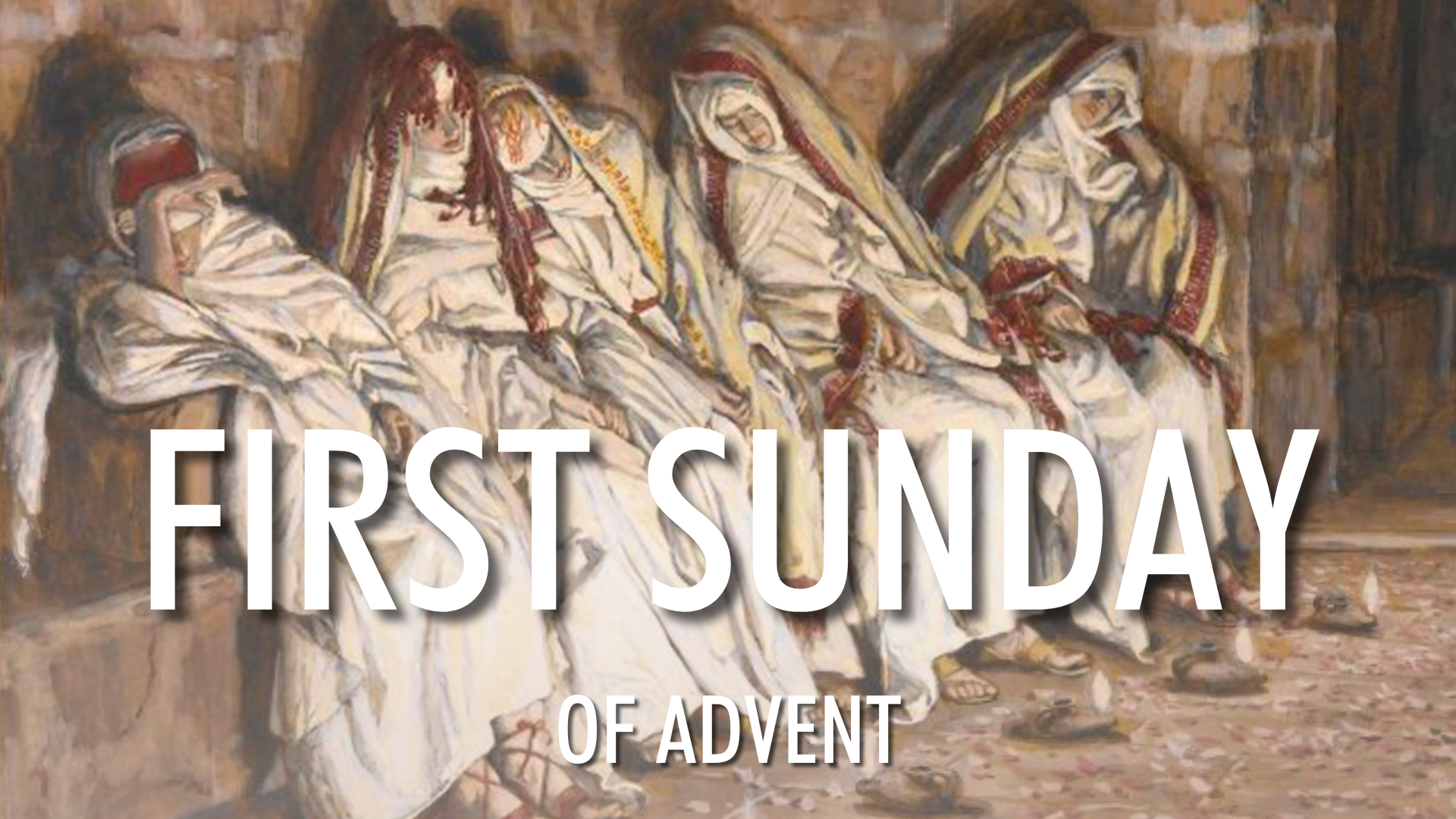
MARK 13:33

Be watchful! Be alert! You do not know when the time will come.

Full Gospel Passage: Mark 13:33-37

Can you believe it? It is only 21 days until Christmas; so much to do, so little time. Thank God Amazon delivers. While Advent is a busy time in which we prepare for Christmas by cleaning, decorating, and shopping, perhaps we should also prepare… just in case Jesus comes back. Can you imagine Christmas morning, Jesus knocking on your door and saying: “I heard you are having a party for my birthday, mind if I join you?” While it may seem far-fetched, we truly don’t know when Jesus is coming back.

He tells us in today’s gospel: “You do not know when the time will come.” If Jesus did come, would we wish that we had more time to prepare? More time to volunteer, more time to help our neighbor, more time to pray, read the bible… anything to prepare for his coming? I doubt we would wish that we had watched more episodes of our favorite TV show or YouTube and TikTok videos. I bet we would wish that we had given Jesus more of our time. We can start by giving our time here at St. James.

- Fr. Paul Stein

Reflection

  • In the midst of the Christmas bustle, what specific actions or changes can you incorporate into your daily routine to ensure that you are allocating meaningful time to volunteer, help your neighbor, and engage in prayer or scripture to grow your relationship with Jesus?
  • Reflecting on Jesus’ return, what adjustments can you make in your priorities to align more closely with what you would value if Jesus were to arrive unexpectedly, such as dedicating more time to prayer, reading the Bible, and serving your community?

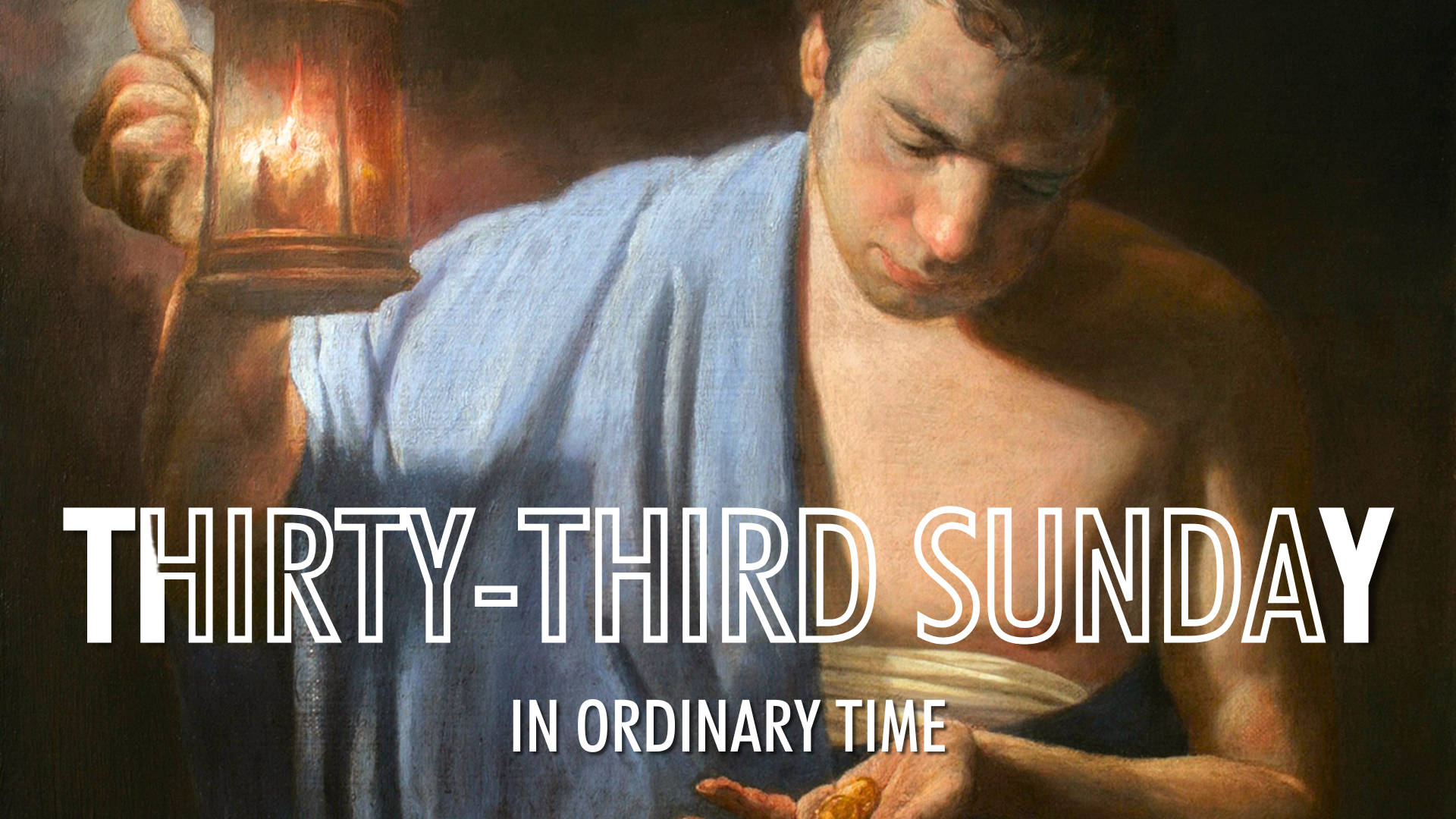
Thirty-Third Sunday in Ordinary Time

MATTHEW 25:21

Well done, my good and faithful servant.

Full Gospel Passage: Matthew 25:14-30

In the parable of the talents from Matthew chapter 25, we hear the familiar lesson from Jesus about the master who gives his talents (money) to three of his servants. He gave them responsibility over very large amounts of money. Two of the servants were good and prudent stewards who invested the money, but the third buried his treasure out of fear. We are all given treasures by God, who may be asking us through this parable to seriously consider what we are doing with that gift.

Time, talent, and treasure are abundant gifts from a generous God. What does our stewardship look like? Are we imitating God’s generosity in building up others and the Church?

- Fr. Ed Pelrine

Prayer for Reflection

Lord Jesus, teach me to be generous. Teach me to serve as you deserve, To give and not to count the cost, To fight and not to heed the wounds, To labor and not to seek to rest, To give of my self and not ask for a reward, Except the reward of knowing that I am doing your will.

- St. Ignatius of Loyola

Thirty-Second Sunday in Ordinary Time

MATTHEW 25:13

Stay awake, for you know neither the day nor the hour.

Full Gospel Passage: Matthew 25:1-13

I remember the shock: it was 1995 and I was in college. A classmate with whom I had many classes in high school died at the age of 20. When you are young, you think you are going to live forever; as you get older, you realize time goes quicker than you think. Jesus’ words are just as true today as they were back then: “Stay awake, for you know neither the day nor the hour.” When I come before the Lord at the end of my life – which could be any day – what will I tell him that I did with all the earthen treasures that he entrusted to my care?

After all, he created the world; everything ultimately belongs to him. Did I freely and gladly return to him what is already his? Did I give of my treasure to the poor and to the Church? It is one thing to bequeath my money after I die and it is no longer any good to me, it is another to lovingly give it away now. I hope to love Jesus intensely now by giving back my treasure so that I may ultimately have treasure in heaven.

- Fr. Paul Stein

Reflection

  • How am I presently stewarding the earthly treasures entrusted to me by God, considering the transient nature of life?
  • How can I more actively share my treasures with the needy and support the Church, embodying a spirit of selfless generosity in the present?
Join us for our Mass livestream Watch Online